TL;DR
- Five detection techniques dissected: perplexity, burstiness, classifier fine-tunes, stylometry, watermarking.
- Stanford: more than half of TOEFL essays by non-native English writers get flagged as AI by commercial checkers.
- Watermarking at source beats detection after the fact. Detectors are still broken in 2026.
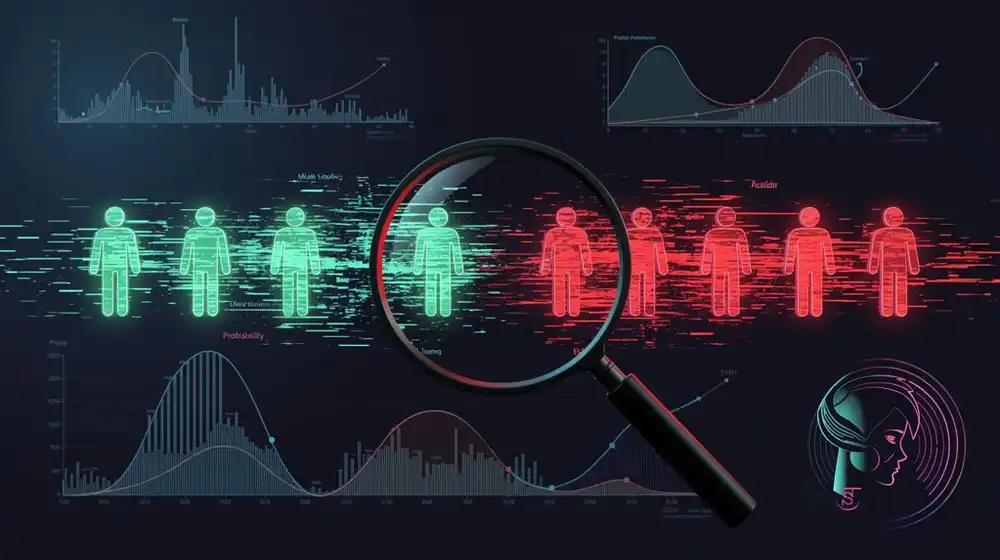
Every few months, another teacher, editor, or HR manager pastes a paragraph into an AI checker, sees a scary red percentage, and fires, fails, or rejects a human. The tool was never meant for that, and if you build content platforms, you need to know exactly how an AI checker reaches that number before you decide whether to trust it in your pipeline.
This is a technical explainer for developers. No product rankings, no affiliate links. We are going to walk through the five families of AI content detection techniques used in 2026, the math behind each one, and the peer-reviewed reasons they still fail on a predictable slice of your users. If you have ever wondered why an AI checker flags your junior writer in Manila but clears your chatbot output, keep reading.
Why the AI checker problem is harder than it looks
An AI checker has a deceptively simple job: given a string of text, return a probability that a language model wrote it. The trouble is that modern open-weight models (Qwen3, DeepSeek-V3.2, GLM-5.1, Llama 4) are trained on the same web corpus as everyone else, optimized with RLHF to sound like a competent human, and then routinely edited by a real human before publication. By the time the text reaches your detector, the statistical gap between "machine" and "person" is measured in fractions of a standard deviation.
That has not stopped the market. Education platforms, journalism desks, and SEO tools all ship AI content checker features as a default. The five techniques below cover more than 95 percent of what those products actually run under the hood.
Technique 1: perplexity scoring
The oldest and still most common AI checker signal is perplexity, the negative log-likelihood of a piece of text under a reference language model. The intuition: language models are trained to minimize perplexity, so their own output sits in a low-perplexity valley that humans rarely visit. A high-perplexity sentence looks surprising to the model, and is more likely human.
Early GPTZero used exactly this trick with a small GPT-2 as the reference model. A smarter variant, DetectGPT (Mitchell et al., ICML 2023), formalized the idea as "probability curvature." The paper observed that machine-generated text sits in negative-curvature regions of the model's log-probability function. DetectGPT perturbs the input with T5 and measures how much the log-prob drops. Machine text falls off a cliff, human text barely moves. The paper reports 0.95 AUROC on GPT-NeoX fake news, up from 0.81 for prior zero-shot baselines.
Why it fails: perplexity is a property of the reference model, not of "humanness." If your detector runs GPT-2 perplexity and the writer used Claude Opus 4.6, the signal is noisy at best. Fluent non-native writers also produce low-perplexity text because they recycle common phrasings, so they look exactly like AI to the scorer.
Technique 2: burstiness and stylometry
The second signal, popularized by the original GPTZero release, is burstiness. Humans vary sentence length wildly inside a paragraph: a nine-word punch followed by a 34-word run-on, then a three-word aside. Language models, tuned for fluent coherence, produce sentence lengths that cluster tightly around a mean. Compute the variance of sentence length (and of perplexity across sentences) and you get a cheap "bursty or not" score.
Stylometric AI checker variants extend this with classical features: type-token ratio (vocabulary richness), average syllables per word, punctuation density, function-word frequency, n-gram repetition. These features have been used in authorship attribution since the 1960s, so the math is boring and well-understood. The problem is that the features are very easy to spoof: ask any modern model for "varied sentence length, occasional fragments, colloquial punctuation" and burstiness collapses as a signal.
Technique 3: supervised classifiers (RoBERTa and friends)
The most widely shipped AI content checker architecture in 2026 is still a fine-tuned encoder classifier. OpenAI released the reference implementation in 2019: roberta-base-openai-detector, a RoBERTa-base fine-tune trained on 5,000 WebText samples vs 5,000 GPT-2 1.5B samples. It hits roughly 95 percent accuracy on in-distribution GPT-2 output and collapses on anything else. OpenAI's own model card says bluntly that accuracy is "not high enough for standalone detection."
Newer community models keep the same recipe with a bigger base and fresher data. SuperAnnotate's roberta-large-llm-content-detector (April 2024) is trained on roughly 20k HC3 and IDMGSP pairs and reports an average F1 of 0.87 across four domains. fakespot-ai/roberta-base-ai-text-detection-v1 (February 2025) is a lighter Apache-2.0 option. None of them claim to generalize outside their training distribution, and all of them quietly inherit the biases of the base model.
Why it fails: classifiers learn the artifacts of the generation distribution they were trained on. Swap the generator (new model, different decoding strategy, a humanizer pass) and the decision boundary drifts. This is why every "99.98 percent accurate" marketing claim you will read in Section 5 comes with an asterisk.
Technique 4: watermarking at source
Watermarking is the only AI checker technique that is mathematically sound, and it is also the one your detector probably is not using. The reference design is "A Watermark for Large Language Models" by Kirchenbauer, Geiping, Wen, Katz, Miers, and Goldstein (ICML 2023). The idea: at generation time, hash the previous token, use it to split the vocabulary into a random "green list" and "red list," and softly boost green-list logits. A human picks green tokens about half the time by chance. A watermarked model picks them far more often, and a simple z-test over a paragraph gives you interpretable p-values.
The upside is that watermarking is model-agnostic at detection time, robust to light paraphrasing, and statistically rigorous. The downside is that it only works if the model's creator cooperates. OpenAI confirmed it had a working text watermark for ChatGPT and chose not to ship it, citing user backlash and easy defeats via translation loops. Google DeepMind shipped SynthID-Text for Gemini in 2024, but only for their own outputs. For the open-weight stack you care about, nothing is watermarked by default in 2026, and an AI checker that advertises "watermark detection" is almost always selling a classifier with extra steps.
Technique 5: embedding similarity and nearest-neighbor lookup
The final family is retrieval-based. Embed every sentence the LLM ever produced, store it in a vector DB, and at check time compute cosine similarity between the candidate text and the nearest K neighbors. If the query is suspiciously close to a stored generation, you have a match. This is the approach behind "GPT output database" style detectors and the content fingerprinting features in Copyleaks and Originality.AI.
It works surprisingly well for copy-paste detection and near-zero for anything else. Paraphrasing, translation, or even a light manual rewrite moves the embedding far enough that cosine similarity drops under the threshold. It is also a privacy problem: storing every LLM output means your detector vendor has the world's largest shadow corpus of user conversations, which is not a risk your compliance team will thank you for.
The false-positive problem is not going away
Every technique above has the same structural weakness: the classes it is trying to separate are converging, not diverging. The most cited proof is "GPT detectors are biased against non-native English writers" by Liang, Yuksekgonul, Mao, Wu, and Zou (Stanford, 2023). The authors ran TOEFL essays and US 8th-grader essays through seven leading AI detectors. Result: detectors flagged more than 50 percent of the non-native essays as AI-generated, while correctly clearing the native ones. In some cases, 97 to 100 percent of non-native samples were misclassified by at least one detector.
The root cause is mechanical. Fluent non-native writers use a smaller, more common vocabulary and produce lower-perplexity text. That is exactly the signal every perplexity-based AI checker rewards as "AI-like." The paper also shows that a one-line prompt ("rewrite this with more literary vocabulary") can flip all seven detectors to "human," which means the same tool that punishes honest students gives determined cheaters a free pass.
Independent replication from 2024 and 2025 puts real-world false-positive rates for the major commercial detectors in the 20 to 50 percent range on edge cases (ESL writing, formulaic business prose, heavily edited drafts). No vendor disputes the direction of that number; they only argue about the exact percentage.
What would actually fix this
If you are building a platform and you need a credible AI content checker, here is what the research actually supports in 2026.
- Watermark at source, detect at destination. If you generate the content, watermark it with the Kirchenbauer scheme (open-source implementations exist for Llama, Qwen, and GLM). Detection is then a hypothesis test with a real p-value, not a vibe check.
- Treat classifier scores as a weak prior, not a verdict. Use them to triage, not to punish. Anything above your "review" threshold goes to a human, not to an auto-reject.
- Ensemble across families. A perplexity score, a burstiness score, and a fine-tuned classifier disagree on different mistakes. Taking the median of three weak detectors is more honest than trusting one confident one.
- Publish your false-positive rate. Any AI checker feature you ship should include a visible FP rate for ESL writers and short passages. Users deserve to see the uncertainty.
- Refuse to make high-stakes decisions on detection alone. This is not a technical fix; it is a policy one. No firing, failing, or rejecting based on a single detector score. The Stanford paper is the reason.
The honest closing
An AI checker in 2026 is a useful triage tool and a terrible judge. The underlying techniques (perplexity, burstiness, classifiers, watermarking, embedding similarity) are each sound within a narrow operating range, and each breaks in predictable ways outside it. The only technique that is statistically clean, watermarking, requires cooperation from model creators who have declined to ship it. Everything else is pattern matching on a moving target.
If you are building a content platform, the right question is not "which AI checker has the highest accuracy." It is "what is my policy when the detector is wrong?" Start there, and every technical choice downstream gets easier.
Your ten-minute action: open roberta-base-openai-detector in a Colab, run three paragraphs through it (one from Claude, one from Qwen, one from a non-native human writer), and note how the three scores line up. The spread you see is the foundation your content policy has to account for.