TL;DR
- 26.4B total, 3.4B active: the middle 12 of 24 layers run three times, so each token sees 48 layers and 5.4B effective active parameters
- Trained in NVFP4 and shipped that way: the 19.5 GB checkpoint is the model as trained, so the 52.2 GB BF16 GGUF holds no extra precision
- The family so far: Inkling 975B, Inkling-Small 276B, Inkling 2 Small 594B, Mini 26.4B and a variable-loop research twin, all Apache 2.0
System Requirements
| RAM | 32GB unified memory or VRAM |
| GPU | 1x DGX Spark, RTX 5090 or a 32GB+ Apple Silicon Mac |
| VRAM | 19.5GB native NVFP4 (17.6GB IQ4_NL GGUF) |
✓ Ollama
✓ Apple Silicon
Inkling 2 Mini is the most-trending model on Hugging Face this week, and the reason is in one number: 19.5 GB. That is the whole weights file for a 26.4B parameter multimodal model from Thinking Machines Lab, Apache 2.0, small enough for a 32 GB Mac, a DGX Spark or a single RTX 5090. The part that makes it more than another small MoE is the architecture. Twelve of its 24 layers run three times for every token, and it is one of the first looped transformers anyone has shipped as a general-purpose open model.
This article covers Mini and the whole family around it: the two first-generation Inkling models, the 594B Inkling 2 Small that went open last week, and a research twin whose loop count you can set at runtime. Everything below comes from the model cards, the config files, the Hugging Face file listings and Thinking Machines' own write-ups. We did not run the model; the note at the end says exactly what was checked.
Inkling 2 Mini and the Inkling family: five models in four months
Thinking Machines published its first open weights in July. Four months later there are five models on its Hugging Face account, every one of them Apache 2.0, plus format variants.
| Model |
Weights released |
Params (total / active) |
Layers and experts |
Inputs |
Native checkpoint |
Self-hosting floor |
| Inkling |
2026-07-15 |
975B / 41B |
66 layers, 6 of 256 experts + 2 shared |
Text, image, audio |
BF16 1,904.7 GB, NVFP4 592.0 GB |
4x B300 or 16x H200 |
| Inkling-Small |
2026-07-30 |
276B / 12B |
42 layers, 6 of 256 experts + 2 shared |
Text, image, audio |
BF16 531.9 GB, NVFP4 170.7 GB |
A multi-GPU node, or a 77 GB GGUF streamed from NVMe |
| Inkling 2 Small |
2026-11-12 (announced 2026-11-05) |
594B / 17B |
48 layers, 8 of 384 experts |
Text, image |
NVFP4 393.5 GB, MXFP8 622.8 GB |
2x B300 or 4x H200 |
| Inkling 2 Mini |
2026-11-20 |
26.4B / 3.4B (5.4B with loops) |
24 layers run as 48, 8 of 128 experts |
Text, image |
19.5 GB NVFP4 + MXFP8 |
32 GB: DGX Spark, RTX 5090, 32 GB Mac |
| TML-d24-varloop-research |
2026-11-20 |
26.4B / 3.4B to 7.4B, by loop count |
As Mini, 1 to 5 loop passes |
Text, image |
19.5 GB, same format |
As Mini; weights only, no API |
All five support a 1M-token context. The Inkling-Small floor comes from colibri 2.1, which published 10.92 to 11.53 tokens per second for its 77 GB UD-IQ2_XXS GGUF on a desktop with a 24 GB card, 62 GB of RAM and NVMe streaming for the rest.
Three things changed between the generations. The second generation dropped audio input: Inkling and Inkling-Small take 16 kHz WAV, the Inkling 2 models take text and images only. The shared experts are gone, and the expert pool grew from 256 to 384 in Small.
The release process changed too. Inkling 2 Small launched on 2026-11-05 as closed weights on Thinking Machines' Tinker platform, following what the lab calls "a safe path to open weights", and the weights followed on 2026-11-12 after external safety testing and red-teaming. Before that, the lab tested early checkpoints anonymously on OpenCode under the name Fledge-Alpha. Mini skipped the waiting period and shipped with open weights on day one.
How the loop works
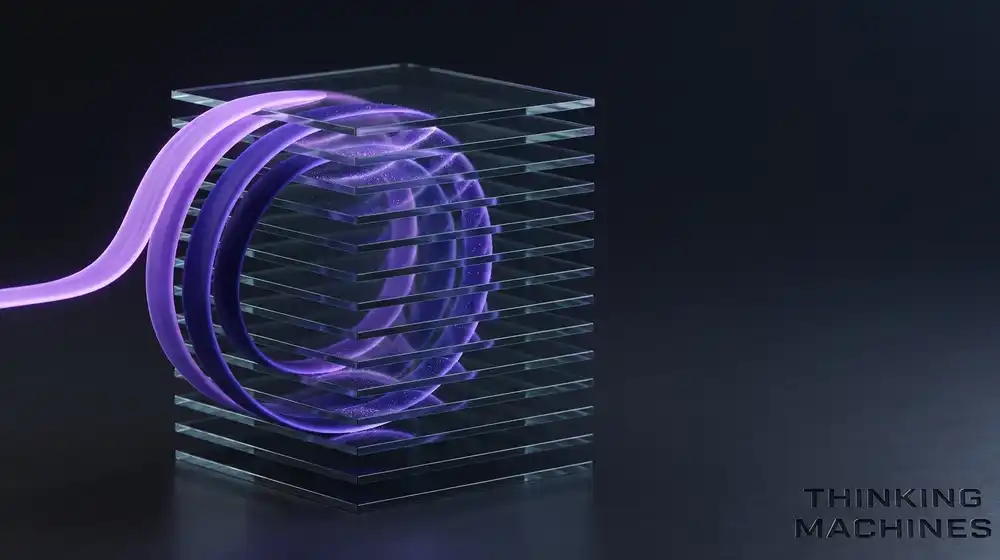
The config file makes the design concrete. The loop_config block reads core_start: 6, core_end: 18, num_passes: 3. So layers 0 to 5 run once, layers 6 to 17 run three times with the same weights, and layers 18 to 23 run once: 48 layer visits per token from 24 stored layers. Inkling 2 Small also does 48 layer visits per token, but with 48 separate layers, twice the hidden size (4,608 against 2,304) and three times the experts.
The passes are not a simple repeat. Every pass through the core starts from the output of the first six layers, and passes two and three also read a "message" from the previous pass through attention residuals. A learned gate decides how much of that message to let in. The gate starts fully closed during training, which is how Thinking Machines introduced looping without destabilising the run.
- Attention: each six-layer block has five sliding-window layers (1,024-token window) and one full-attention layer. In the config the full-attention layers are 5, 11, 17 and 23.
- Experts: 128 per layer, 8 routed per token, no shared expert, 1,152 intermediate width each.
- Drafter: a three-layer DSpark head for speculative decoding ships alongside the model as a separate 0.64 GB
mtp.safetensors file.
- Vision: a 23-layer ViT, with images and text processed jointly by the decoder.
Mini is not the only looped model this week. SenseNova-Loop-9B, also Apache 2.0, reuses layer weights through a loop of its own and landed three days earlier. Two labs shipping the same idea in one week is usually a sign it is about to become a normal design choice.
Mini did not start at this size. It began on the same recipe as its bigger siblings with 8 of 384 experts, had two thirds of the experts pruned in a single step during midtraining, and was then "healed" on 1T tokens distilled from a larger internal Inkling. Post-training was SFT followed by an RL run of 2.2T tokens over 2,000 steps. Thinking Machines' justification for looping is one comparison on its scaling ladder: the non-looped model cost 7.5% less to train, but needed 140% more inference compute to match the looped model's loss on 512K-token agentic traces.
Why 20 GB is the real number, and the BF16 GGUF is not
Most local models are trained in 16-bit and then quantised down, so a bigger file usually means better quality. Inkling 2 Mini runs the other way. Its expert layers were trained in 4-bit NVFP4 on every forward pass from pretraining through RL, the last four layers in 8-bit MXFP8, and the checkpoint ships in exactly those formats. The 19.5 GB file is the model as trained, not a compression of something bigger.
That makes the GGUF list read strangely. These are the files people are actually downloading:
| File |
Size |
Against the 19.5 GB original |
| ggml-org BF16 GGUF |
52.22 GB |
2.7x larger, same information |
| ggml-org Q8_0 |
27.82 GB |
42% larger |
| Unsloth UD-Q8_K_XL |
22.86 GB |
17% larger |
| ggml-org IQ4_NL |
17.62 GB |
10% smaller |
| Unsloth UD-Q4_K_M |
16.61 GB |
15% smaller |
| Unsloth UD-IQ2_XXS |
8.48 GB |
57% smaller |
| Unsloth UD-IQ1_S |
7.76 GB |
60% smaller |
An 8-bit or 16-bit GGUF of a model whose experts were trained in 4-bit cannot hold more precision than the 4-bit weights it was converted from. It is the same values in a bigger container. The 4-bit GGUFs are a different problem: they re-quantise NVFP4 values into another 4-bit format, which adds conversion error to save 10 to 15%. The runtimes that load the native checkpoint, MLX and Ollama on Apple Silicon and SGLang and vLLM on Blackwell, skip that step entirely, which is what the Hugging Face team means when it says MLX gives you "the original quality the authors intended".
Nobody seems to care, judging by the download counters. The Unsloth GGUF repository shows 1,292,888 downloads and ggml-org's 497,658, against 41,888 for the official checkpoint. If you are on llama.cpp, the GGUF is still your only path, and IQ4_NL or Q4_K_M are the sensible picks. Just do not pay 52 GB of disk for a "full precision" file that is not.
The memory nobody puts on the box: the KV cache
The loop also changes the long-context bill. Each of the 48 layer visits keeps its own KV state, and two of the four full-attention layers, 11 and 17, sit inside the looped core. That makes 8 full-attention visits per token instead of 4, each with 8 KV heads of dimension 128.
By our arithmetic from config.json, that is 32 KiB of KV cache per token at 16-bit, before any KV quantisation your runtime may apply. The sliding-window layers are capped at 1,024 tokens and add only about 170 MB in total. The context, not the weights, decides whether Mini fits:
- 128K tokens: about 4.3 GB of KV on top of the weights. This fits on a 32 GB machine.
- 1M tokens: about 34.4 GB of KV. That does not fit beside 19.5 GB of weights on any 32 GB device, whatever the card says about the context window.
The research twin: what more loops buy
TML-d24-varloop-research has the same architecture and size as Mini, but it was trained with 1 to 5 passes through the core (sampled 1:2:6:2:1), so you choose the loop count at inference time. Its model card publishes the same benchmarks at every pass count, which is the clearest public data yet on what looping does. Thinking Machines warns that the two models' later training stages differ, so compare across pass counts, not against Mini.
| Benchmark |
1 pass |
2 passes |
3 passes |
4 passes |
5 passes |
Inkling 2 Mini |
| DeepSWE v1.1 |
0.7% |
28.3% |
47.4% |
46.9% |
48.2% |
48.2% |
| SWE-bench Verified (bash only) |
56.3% |
76.5% |
78.7% |
79.3% |
79.6% |
79.2% |
| MRCR v2, 8-needle, 512K to 1M |
20.6% |
49.7% |
72.3% |
81.4% |
79.9% |
37.7% |
| GraphWalks BFS, 1M |
5.7% |
39.4% |
52.1% |
56.2% |
57.8% |
50.0% |
| ARC-AGI-2 (Public) |
0.8% |
12.2% |
22.1% |
20.3% |
27.1% |
51.3% |
| SimpleQA Verified |
6.3% |
6.5% |
7.3% |
6.8% |
6.7% |
8.4% |
| Destructive actions (internal, lower is better) |
26.6% |
16.4% |
7.8% |
3.1% |
7.0% |
10.2% |
Three things stand out. One pass is not a usable agent: DeepSWE falls to 0.7%. Two passes already recover most of SWE-bench Verified (76.5% against 79.2%), and Hugging Face notes that fewer passes run "a lot faster", so two is a real speed setting for short coding tasks. And knowledge does not move at all: SimpleQA Verified sits between 6.3% and 7.3% at every pass count, which matches Thinking Machines' own summary that looping buys reasoning, not stored facts.
Long context is where the loop pays most, and where the oddity in this release sits. At three passes the research model scores 72.3% on 512K-to-1M MRCR, against 37.7% for Mini, which always runs three. On the 256K-to-512K slice the gap is wider still, 89.2% against 46.4%, while Mini beats the twin by 29 points on ARC-AGI-2 at the same three passes. Thinking Machines recommends Mini for production; if your workload is retrieval over very long documents, the published numbers say the research model deserves a test.
Benchmarks: where Mini wins, and where it does not
Every figure below is from Thinking Machines' model card, against the small open models it chose as rivals. Parameter counts are active / total, and Mini's 5.4B counts the loops.
| Benchmark |
Inkling 2 Mini (5.4/26.4) |
Qwen3.8-27B (27/27) |
Muse Glimmer (30/30) |
Gemma 4 31B (30.7/30.7) |
Nemotron 3.5 Super VL (12/124.5) |
| AA Index v5.0 |
20.1 |
20.1 |
6.3 |
4.4 |
13.6 |
| SWE-bench Verified (bash only) |
79.2% |
77.8% |
76.0% |
46.1% |
71.1% |
| DeepSWE v1.1 |
48.2% |
42.2% |
4.4% |
0.3% |
24.7% |
| Terminal Bench v2.1 |
71.6% |
73.0% |
51.7% |
43.4% |
60.7% |
| BrowseComp (with compaction) |
79.0% |
61.6% |
63.9% |
37.0% |
78.9% |
| MCP Atlas (Public) |
82.7% |
77.3% |
75.5% |
54.2% |
67.7% |
| GDPVal-AA v2.1 |
1319 |
1427 |
792 |
627 |
1162 |
| AutomationBench-AA v1.0.6 |
41.8% |
48.2% |
6.8% |
4.9% |
14.8% |
| AA-Omniscience non-hallucination rate |
63.4% |
71.4% |
16.4% |
14.5% |
69.5% |
The honest summary is a tie with Qwen3.8-27B on the headline index, with Mini ahead on agentic coding and search and Qwen ahead on knowledge work and instruction-heavy tasks. Thinking Machines' own limitations section concedes MultiChallenge (50.0%) and ComplexConstraints v1.1 (33.4%), both behind Qwen. Mini also gets there with a fifth of the active parameters, which is the point of the design.
Two cautions before you quote this table. Gemma 4 31B scoring 0.3% on DeepSWE and 0.0% on FrontierCode reads like a harness that did not work with that model, not a measure of it; the blog itself notes that "evaluation setups vary by model". And the same Mini shows two different ARC-AGI-1 scores, 84.5% on its own card and 90.5% on the research twin's card labelled "Public", so check the split before you compare.
For the big sibling, one line is enough. Inkling 2 Small scores 30.6 on the AA Index, behind DeepSeek-V4.1-Flash-1017 at 32.6 and ahead of GLM-5.3-Flash at 27.8, and it posts the best BrowseComp (90.2%) and JobBench (70.5%) scores in its 13-model comparison table, closed models included.
Does looping hide reasoning from the chain of thought?
This is the safety question looped models raise. A normal transformer has a fixed number of serial steps per token, so long reasoning has to be written out where a monitor can read it. Looping adds serial steps without adding tokens. Thinking Machines tested whether that makes the chain of thought less informative, and published the results.
- Reasoning without writing: the research model's no-chain-of-thought time horizon rose from 16 seconds of human task time at one pass to 37 seconds at three, then flattened. On a chained lookup task it kept improving out to ten loops, twice what it was trained on.
- Shorter but readable: on GPQA Diamond questions answered correctly at every pass count, reasoning at five passes averaged 1,661 tokens against 3,703 at one pass, with sentence length and dictionary-word share unchanged. The model backtracked less; it did not become harder to read.
- Poor control over its own reasoning text: asked to steer its chain of thought, for example to avoid a keyword, Mini complied at most 0.1% of the time on chains of 750 to 1,250 tokens, against 1.3% for Qwen3.8-27B.
The lab's conclusion is that looping "increases what these models can do without a verbalized chain of thought, but at this scale we do not see a meaningful reduction in the monitorability of their reasoning". That is a first-party finding at 26B. The reason the research twin exists is so others can test it.
Run Inkling 2 Mini locally
On an Apple Silicon Mac with 32 GB or more, Ollama serves the native 20 GB checkpoint. The latest, 26b-a5b and 26b-a5b-nvfp4 tags are the same file. The model card lists Ollama under Apple Silicon specifically.
ollama run inkling-2-mini
On Linux, Windows or any NVIDIA or AMD card, use llama.cpp with the ggml-org GGUF. This is the command from the Hugging Face launch post; it pulls the 17.6 GB IQ4_NL build and serves an OpenAI-compatible API.
llama serve -hf ggml-org/Inkling-2-Mini-GGUF:IQ4_NL

# the research twin, same command shape
llama serve -hf ggml-org/TML-d24-varloop-research-GGUF:IQ4_NL
On a Mac with MLX, the native NVFP4 and MXFP8 weights load without reconversion:
pip install -U mlx-lm
mlx_lm generate --model thinkingmachines/Inkling-2-Mini \
  --prompt "Explain what a looped transformer is in three sentences." -m 1000
In Python with transformers, reasoning effort is a chat-template argument. The levels are none (0.0), minimal (0.1), low (0.2), medium (0.7), high (0.9, the default), xhigh and max (both 0.99), or any number from 0.0 to 0.99.
from transformers import AutoModelForMultimodalLM, AutoProcessor

model_id = "thinkingmachines/Inkling-2-Mini"
processor = AutoProcessor.from_pretrained(model_id)
model = AutoModelForMultimodalLM.from_pretrained(model_id)

messages = [{"role": "user", "content": [{"type": "text", "text": "Why is the sky blue?"}]}]
inputs = processor.apply_chat_template(
    messages, reasoning_effort="low", tokenize=True,
    add_generation_prompt=True, return_dict=True, return_tensors="pt",
).to(model.device)

input_len = inputs["input_ids"].shape[-1]
outputs = model.generate(**inputs, max_new_tokens=1024)
print(processor.decode(outputs[0][input_len:], skip_special_tokens=True))
For the research twin, the loop count is a config override at load time. Two passes is the interesting setting:
model = AutoModelForMultimodalLM.from_pretrained(
    "thinkingmachines/TML-d24-varloop-research",
    text_config={"loop_num_passes": 2},
)
For serving on datacenter hardware, there are day-zero SGLang and vLLM recipes. The SGLang example targets SM103, which means a B300, and enables the DSpark drafter with --speculative-algorithm DSPARK. Inkling 2 Small is a different conversation: 2x B300 or 4x H200 for the NVFP4 checkpoint, or an API through NVIDIA, Fireworks, Together, Baseten, Nebius, Modal or Cloudflare.
Limitations and gotchas
- It can loop in the other sense. The card reports the model getting stuck in long reasoning loops or re-checking its own work without progress, especially when debugging. Set limits on output tokens and agent turns.
- It may delete files without asking. Thinking Machines writes that Mini "may take destructive actions, such as deleting or overwriting files, without confirmation, and may not report the outcome of its work accurately". Run agent work in a sandbox and require confirmation for anything irreversible.
- "none" does not mean none. Setting reasoning effort to the minimum does not fully disable reasoning, so budget latency accordingly.
- Active parameters understate the compute. The core runs three times, so per-token compute is closer to a 5.4B dense model's than a 3.4B one's, and runtime support for looped models is new. Speed varies a lot between runtimes.
- The 1M context does not fit at home. By the arithmetic above, the full window needs about 34 GB of KV cache at 16-bit, on top of the weights.
- Weaker outside English. The card reports clipped phrasing and mixed languages in Chinese testing.
- No audio. If you need speech in, the first-generation models are still the only Inkling option.
- Uncensored repacks are trending. One sits at #4 on Hugging Face with 329,497 downloads. Apache 2.0 allows it, but those builds exist to strip the refusal behaviour the card describes, so the guardrails become your job.
Which Inkling should you run?
A 32 GB Mac or a DGX Spark, local coding agent: Inkling 2 Mini on the native checkpoint through Ollama or MLX. Keep the context to 128K or so, cap the turns and run it in a sandbox. Our DGX Spark versus Mac Studio comparison covers the hardware trade-offs.
A 24 GB GPU: the IQ4_NL or Q4_K_M GGUF through llama.cpp, which leaves room for roughly 100K tokens of context at a 16-bit KV cache, more if you quantise the cache. Our Ollama vs llama.cpp vs vLLM guide covers which server to put in front of it.
Research on looped models or long-document retrieval: TML-d24-varloop-research, at two passes for speed or four for long context. It is not offered through any API, including Tinker.
Knowledge-heavy work or a production API: Inkling 2 Small, rented through one of the listed providers. Mini's own card says the biggest gap to Small is factual recall.
Speech input: the first-generation Inkling or Inkling-Small, which remain the family's only audio models.
Sources and further reading
- thinkingmachines/Inkling-2-Mini model card, with the full benchmark table and limitations
- Inkling 2 Mini config.json, the source of the loop and attention layout
- TML-d24-varloop-research model card, with results at 1 to 5 passes
- thinkingmachines/Inkling-2-Small model card and Inkling-Small model card
- Introducing Inkling 2 Mini, Thinking Machines' post on looping, pruning and monitorability
- Introducing Inkling 2 Small, including the closed-first release and the Fledge-Alpha test
- Welcome Inkling 2 Mini, the Hugging Face post with the transformers, llama.cpp, SGLang and MLX instructions
- ggml-org/Inkling-2-Mini-GGUF and unsloth/Inkling-2-Mini-GGUF, the file sizes in the table above
- inkling-2-mini on Ollama
- Our earlier coverage: Inkling, the first generation
The ten-minute version: on a 32 GB Mac, run ollama run inkling-2-mini, give it a coding task in a throwaway directory and watch how few reasoning tokens it needs. Then ask yourself how much context you really use, because that number, not the 19.5 GB, decides whether this model fits your machine.
Not independently tested. Every figure here comes from the Thinking Machines model cards and blog posts, the Inkling 2 Mini config file, the Hugging Face blog, the Hugging Face file and download listings, the Ollama library page, or our own arithmetic on those. The KV cache figures assume a 16-bit cache with no KV quantisation and no vision tokens. No part of any Inkling model was run on our hardware.
Date checked: 2026-11-23
Frequently asked questions
Can Inkling 2 Mini run on a laptop?
Yes, on one with 32 GB of unified memory or VRAM. The native checkpoint is 19.5 GB in NVFP4 and MXFP8, and Thinking Machines lists a DGX Spark, Apple Silicon Macs with 32 GB or more, and GPUs with 32 GB of VRAM. On a Mac, Ollama serves it with ollama run inkling-2-mini; on other hardware llama.cpp runs the 17.6 GB IQ4_NL GGUF. Long contexts need extra memory for the KV cache, about 4.3 GB at 128K tokens by our arithmetic, so the full 1M-token window does not fit on a 32 GB machine.
What is a looped transformer?
A transformer that runs some of its layers more than once per token, reusing the same weights. Inkling 2 Mini stores 24 layers but runs the middle 12 three times, so every token passes through 48 layers. That adds reasoning depth without adding parameters: Thinking Machines counts 5.4B effective active parameters per token against 3.4B stored active ones.
Is Inkling 2 Mini better than Qwen3.8-27B?
On Thinking Machines' own benchmarks they tie on the Artificial Analysis Index at 20.1. Inkling 2 Mini leads on agentic coding and search, for example 79.2% against 77.8% on SWE-bench Verified and 48.2% against 42.2% on DeepSWE, while Qwen3.8-27B leads on Terminal Bench 2.1, knowledge work and multi-constraint instructions. Inkling 2 Mini gets there with about a fifth of the active parameters. All of these figures are first-party.
Is Inkling 2 Mini open source?
Its weights are released under Apache 2.0, the same licence as every other Inkling model, so commercial use, fine-tuning and redistribution are allowed under the standard Apache terms. Thinking Machines also links a separate model acceptable use policy from the model card. The training data itself is not released; the lab publishes training data documentation instead.
What is TML-d24-varloop-research?
A research twin of Inkling 2 Mini with the same size and architecture, trained to run its looped layers 1 to 5 times so you can choose the loop count when loading it. Thinking Machines released it to study how looping changes capability and chain-of-thought monitorability, and recommends Inkling 2 Mini for production. It is weights-only with no API access. Two passes run faster at a small quality cost, and four passes scored best on its long-context retrieval tests.